Why strength training after 40 matters so much
From your 30s onward you gradually lose muscle mass. This process, called sarcopenia, accelerates around age 40 and speeds up even further after menopause. Without targeted training you can lose up to 25% of your muscle mass between the ages of 30 and 70. That may sound like a distant concern, but you feel the consequences much sooner: you tire more easily, your metabolism slows, your joints become more vulnerable, and everyday tasks like carrying shopping bags or climbing stairs become harder.
Strength training is the only type of exercise that can actually reverse this process. Cardio is great for your heart and fitness, but it does not build muscle mass. Yoga and pilates are wonderful for flexibility and core stability, but they do not provide enough resistance to make your muscles truly stronger. Strength training does — and the benefits go far beyond stronger muscles alone.
Key point: Strength training is the only form of exercise proven to build muscle mass, strengthen bones and raise your metabolism. After 40 it is not a luxury — it is a necessity.
Muscle mass and metabolism: what changes
Your muscles are the engine of your metabolism. Muscle tissue burns more energy at rest than fat tissue: every kilogram of muscle burns roughly 13 kilocalories per day, while a kilogram of fat uses only 4. That difference seems small, but across several kilograms and years of muscle loss it adds up considerably.
Many women notice around age 40 that they gain weight despite eating no differently than before. The explanation is often simpler than you think: you have less muscle mass, so your body burns less energy at rest. Your calorie needs decrease, but your eating habits stay the same. The result? Gradual weight gain, especially around the abdomen.
Through strength training you not only preserve your existing muscle mass, but you can actually build new muscle. Yes, even after 40. Research shows that women at any age can gain muscle mass, provided they get sufficient training stimulus and adequate protein. Your body adapts to the demands you place on it — that does not change with age.
There is also the so-called afterburn effect: after a solid strength training session your metabolism stays elevated for hours. Your body uses extra energy to repair and strengthen your muscles. That effect is significantly greater with strength training than with a gentle walk or a yoga class.
Strong bones: your best protection against osteoporosis
Osteoporosis is a silent threat. You feel nothing until you break a bone, and by then it is often already advanced. After menopause your oestrogen level drops, and oestrogen plays a crucial role in maintaining your bones. Women lose an average of 10% of their bone density in the first five years after menopause.
Strength training is one of the few proven ways to maintain and even improve bone density. When muscles pull on bones during weight lifting, your body responds by making the bones stronger. This mechanism — Wolff's Law — works at any age.
Important: the load must be sufficient. Light weights of one kilogram have little effect on bone density. Research shows you need to train with moderate to heavy weights to genuinely stimulate your bones. That does not mean you need to squat 50 kilograms from day one, but it does mean progressively building toward weights that truly challenge you.
Did you know: Women who do strength training twice a week gain an average of 1–3% bone density in the hip and spine? By comparison: without training you actually lose bone density in that same period.
Strength training and hormone balance
The hormonal changes around menopause affect virtually every system in your body. Declining oestrogen, fluctuating progesterone, changes in cortisol and insulin sensitivity: it is a complex interplay. Strength training can contribute positively to your hormone balance on multiple fronts.
Insulin sensitivity: Muscle mass is your largest organ for glucose uptake. The more muscle mass you have, the better your body can absorb sugars from your blood. This lowers your risk of insulin resistance and type 2 diabetes — risks that increase after menopause.
Cortisol: Chronic stress keeps your cortisol level elevated, leading to abdominal fat, sleep problems and fatigue. Strength training in the right dose helps regulate cortisol. Note: too much and too intense training can actually raise cortisol. Two to three sessions per week is ideal for most women.
Growth hormone: Strength training stimulates the production of growth hormone, which plays a role in muscle building, fat burning and cell repair. Growth hormone production declines with age, but strength training is one of the most powerful natural ways to stimulate its production.
Serotonin and endorphins: Training hard gives you a dose of feel-good hormones. Many women in menopause experience mood swings, and regular strength training can make a noticeable difference. It provides not only physical strength, but also mental resilience.
Ana Mendes, sports coach at FEM Rebalance, sees it daily with the women she coaches: "Many women come in thinking they're too old to start strength training. After six weeks they feel stronger, more energetic and more stable — both physically and mentally."
The best exercises to start with
If you have not trained with weights before, it is important to start with compound exercises — exercises that work multiple muscle groups simultaneously, so you achieve more results with fewer exercises.
The 5 fundamental movements
1. Squat
Trains: quadriceps, glutes, core
Start with: bodyweight squats or goblet squats with a kettlebell
Key points: push your knees outward, keep your chest up and go as deep as is comfortable. You don't need to reach full depth right away.
2. Deadlift
Trains: hamstrings, glutes, lower back, core
Start with: Romanian deadlift with light dumbbells or a kettlebell
Key points: keep your back straight, hinge from your hips and feel the stretch in your hamstrings. This is the most functional exercise there is — think of picking something up from the floor.
3. Row
Trains: upper back, rear shoulders, biceps
Start with: dumbbell row supported on a bench
Key points: squeeze your shoulder blades together and control the movement. A strong back dramatically improves your posture.
4. Press (push)
Trains: chest, shoulders, triceps
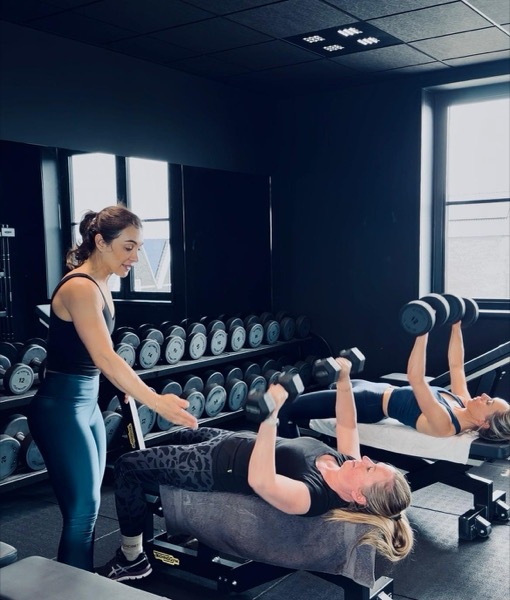
Start with: push-ups on your knees or against a wall, or dumbbell chest press on a bench
Key points: keep your core engaged and don't let your elbows flare out too wide.
5. Hip-dominant exercise (hip thrust / glute bridge)
Trains: glutes, hamstrings
Start with: glute bridge on the floor, later with added weight
Key points: squeeze your glutes at the top and avoid excessive lower-back arch.
Ana's tip: In the beginning, focus on technique, not on weight. Learn to perform the movements correctly with light weight. After two to three weeks you can start gradually adding load. Learning to move well is an investment that pays dividends for the rest of your life.
Accessory exercises as a supplement
In addition to the five fundamental movements you can add supplementary exercises for extra variety and focus:
- Farmer's carry: walk with heavy weights in your hands. Great for grip strength, core and overall stability.
- Pallof press: an anti-rotation core exercise that is far more functional than crunches.
- Step-ups: step up with weights in your hands. Trains balance and leg strength unilaterally.
- Face pulls: a must for healthy shoulders and good posture.
How often and how heavy: a practical schedule
A common question: how often should I train? The short answer: two to three times per week is sufficient to achieve significant results. You don't need to be in the gym every day — in fact, your muscles don't grow during training, but during the recovery that follows.
Sample week for beginners
Day 1: Lower body & core
- Goblet squat: 3 sets of 10–12 reps
- Romanian deadlift: 3 sets of 10–12 reps
- Glute bridge: 3 sets of 12–15 reps
- Pallof press: 3 sets of 10 per side
Day 2: Upper body & back
- Dumbbell row: 3 sets of 10–12 reps
- Push-ups (modified): 3 sets of 8–12 reps
- Dumbbell shoulder press: 3 sets of 10–12 reps
- Face pulls: 3 sets of 12–15 reps
Day 3: Full body
- Step-ups: 3 sets of 10 per leg
- Hip thrust: 3 sets of 10–12 reps
- Dumbbell row: 3 sets of 10–12 reps
- Farmer's carry: 3 sets of 30–40 metres
How much weight?
Choose a weight where the last two reps of each set are challenging, but you can still maintain good technique. This is called training to RPE 7–8 (on a scale of 1 to 10 for effort). You don't need to train to complete failure — that increases injury risk without much extra benefit.
Build gradually each week: a little more weight, one extra rep or an extra set. This principle of progressive overload ensures your body keeps adapting and getting stronger.
Recovery is equally important
Give yourself at least one rest day between two strength sessions targeting the same muscle groups. Sleep is crucial: aim for 7–8 hours per night. And don't forget protein: your body needs building blocks to repair and grow muscles. Target at least 1.2 to 1.6 grams of protein per kilogram of body weight per day.
5 persistent myths debunked
Myth 1: "It will make me big and bulky"
This is the most commonly heard fear, and also the most unfounded. Women have far less testosterone than men — the hormone responsible for significant muscle growth. What you will get is a leaner, firmer body with great shape. The bodybuilders you see on Instagram train with extreme intensity for years and follow strict diets (and often more than that).
Myth 2: "I'm too old to start"
Research shows that even people in their 80s and 90s can still build muscle mass and strength with strength training. At FEM Rebalance we see that women of 40, 50 and 60+ respond excellently to a well-structured programme. It is never too late, but the sooner you start, the more you benefit.
Myth 3: "Cardio is better for weight loss"
Cardio burns calories during the activity, but strength training raises your metabolism structurally. A combination is ideal, but if you have to choose, strength training delivers more for your body composition in the long run. Moreover, more muscle mass means you burn more calories even at rest.
Myth 4: "Light weights with lots of reps will tone me up"
The idea of "toning" with 1-kilogram pink dumbbells is outdated. To make your muscles grow and your bones stronger, you need sufficient resistance. That doesn't mean you should train extremely heavy straight away, but you do need to be challenged. If you can easily keep going after 15 reps, the weight is too light.
Myth 5: "Strength training is dangerous for my joints"
The opposite is true. Correctly performed strength training strengthens the muscles, tendons and ligaments around your joints, making them better protected. Inactivity and weak muscles are a far greater risk for joint problems than controlled weight training. Start with proper technique and build up gradually.
In summary: Strength training does not make you bulky, is safe and effective at any age, and delivers more than cardio alone. It is the best investment you can make in your health after 40.